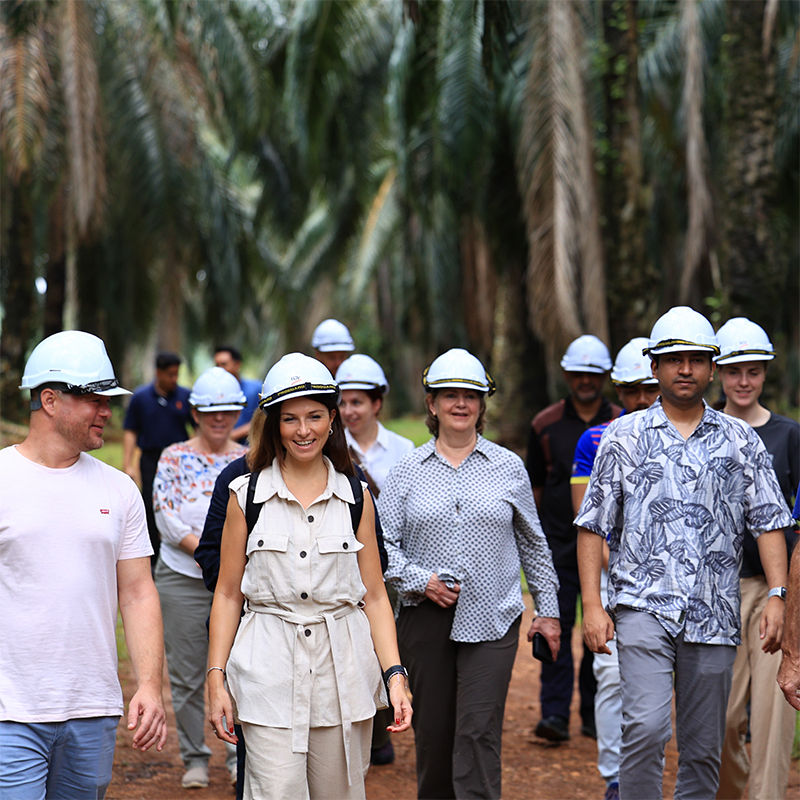
Of Cattle and Oil Palm: A Smallholder’s Journey
We are committed to a future where Malaysian palm oil is renowned for quality and positive contributions to the planet and society.
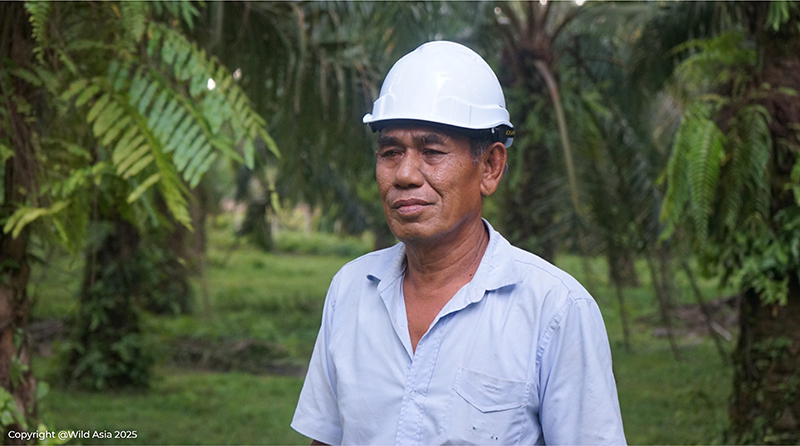
Yusof Endut, a former welder, chose to retire early at 50 to embark on a farming journey in Kinta.
“WHEN done right, livestock and agriculture are not just livelihoods, but pathways to a better life,” says independent oil palm smallholder Mohd Yusof Endut.
“Invest in the land, and the land gives back to you.”
The 62-year-old farmer shares his farming philosophy as we lounge in a rest hut on his 10-acre oil palm farm in Tanjung Tualang, Perak.
Nearby, a herd of cows, their calves in tow, graze lazily under the palm trees while flicking their tails to deter flies and bees. Butterflies flutter over woody shrubs amidst the lush ground cover. The occasional egret or two glides in to join the cattle party. A gentle breeze wafts from the pond along the eastern edge of his farm.
Beyond the pastoral idyll, the farm is a showcase of agriculture returning to its roots. Yusof has been practising livestock integration with oil palm for 15 years.
For ages, the cultivation of crops was intertwined with the raising of animals. However, with the advent of modern agriculture, including intensive crop monoculture and industrialised meat and dairy production systems that aim to churn out commodities as efficiently and cheaply as possible, this age-old practice has been set aside.
However, today there has been a resurgence in integrating livestock and crops on farms, as regenerative agriculture, with its focus on improving soil health, biological diversity, and carbon cycling, gains traction. Research has shown strong links between how plants and animals are managed aboveground and the enhancement of carbon storage and nutrient cycling in the soil.*
Yusof’s cows help manage weeds naturally while enriching the soil with manure. Grazing stimulates plant regrowth, boosting carbon absorption. His healthy farm harbours a habitat for birds, pollinators, predatory insects, earthworms, and microbes, all of which are intrinsically linked. His chemical-free approach, with no herbicides and pesticides, has kept pests at bay and yielded steady results, averaging 1 to 2 tons of fresh fruit bunches (FFB) per acre.
His herd now numbers around 40. Calf mortality rate averages 2%, mainly due to stillbirths.
“On average, I sell about five to seven cows a year. With a market price starting from RM4,500, the earnings more than cover my farm’s production costs. The rest is a bonus for the hard work!” Yusof adds, chuckling.
The Learning Curve
Yusof’s farming journey began at 50, after his welding job in Perak was made redundant. Offered a transfer to Negeri Sembilan or Dubai, he chose early retirement instead, opting to stay rooted in his hometown in Kinta District.
At that time, he had already dabbled in buffalo and giant freshwater prawn farming.
“My first two ventures (buffalo and prawn farming) failed because I was juggling a full-time job and couldn’t give my 100%,” admits Yusof. “But every setback is a chance to learn and grow.”
As they say, the third time’s a charm.
So when he started cattle farming, he learned from past failures and sought guidance from a friend, now a mentor, who operates a cattle feedlot. Five years into cattle farming, the father of three with school-age children decided to plant oil palm in 2012. He used his severance pay and a bank loan to purchase seedlings.
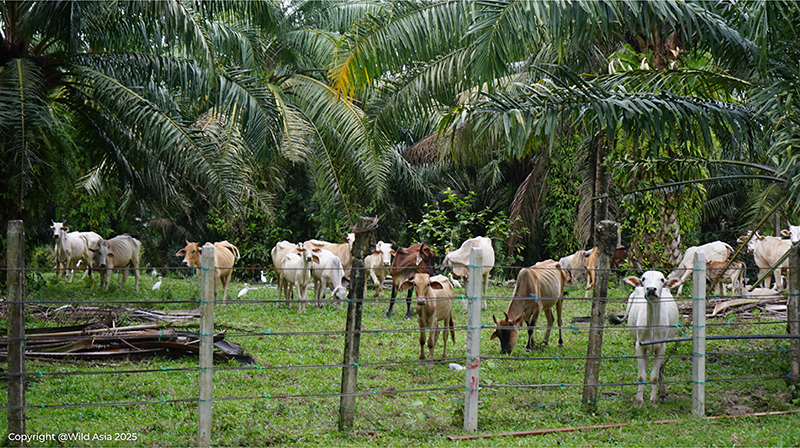
Crop-livestock integration in regenerative agriculture helps rejuvenate soil health, thereby enhancing palm oil field growth.
One of the first lessons he learned about crop-livestock integration is to keep cattle away from palms younger than 5 years, as they are vulnerable to damage from grazing. Cows are creatures of habit. Yusof established a predictable feeding routine with quality feed and adequate space and ventilation in the barn. Instead of relying on store-bought feed grains, he crafts a blend of homegrown Napier grass, corn stalks from a friend’s farm, and decanter cake sourced from a nearby mill.
“From the start, I don’t use any herbicides because I want to maintain ground cover so the soil can retain moisture and to ensure the vegetation is safe for my cows to eat,” Yusof explains. He performs manual weeding around the tree trunks, and the cuttings are turned into compost, enriched with cow dung, and returned to the soil, boosting its fertility, structure, and water retention.
“The first five years of the palm life cycle are the most challenging. You must monitor, fertilise, weed, and control pests to achieve healthy growth and future yields. It’s just like raising a child!” Yusof quips.
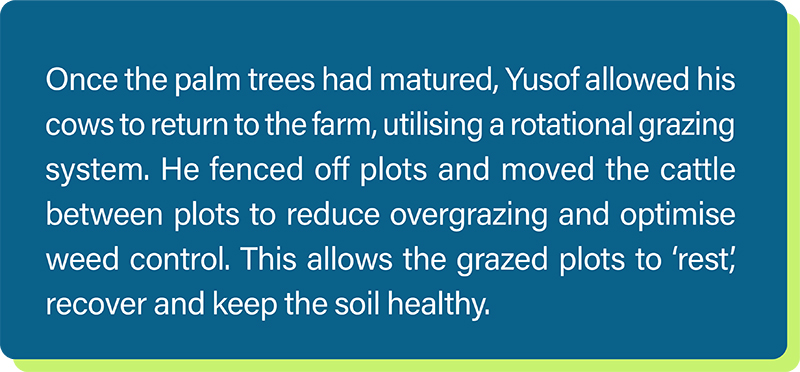
In a 2013 study on the benefits of integrating livestock with oil palm, Malaysia’s Department of Veterinary Services (DVS) recommends a stocking rate of 2 cows per hectare (1 cow per acre). Stocking rate is the number of animals grazing a specific area of land over a defined period. It impacts livestock production and pasture sustainability.
For smallholders, the biggest stumbling block to adopting livestock integration is limited land. Yusof is fortunate to graze his cattle on a neighbouring 40-acre oil palm plot, thanks to a far-sighted landowner. “It’s a win-win. My cows provide natural weed control and organic fertiliser, and I cover the fencing costs, which also helps deter trespassers and livestock thefts,” says Yusof, who received his MSPO (Malaysian Sustainable Palm Oil) certification in 2021.
Yusof joined the Wild Asia Group Scheme (WAGS) in 2023 to further improve his farm management practices. More than just gaining farming know-how, Yusof is eager to tap into Wild Asia’s network of farmer community, expert guidance and global market.
“We grow by learning from others and staying curious. That’s why building meaningful connections matters,” Yusof shares.
“For me, the real value is knowledge.”
Data Speaks
Since 2000, the Malaysian Palm Oil Board (MPOB) has promoted the integration of livestock into oil palm plantations as a strategy to optimise land use, increase farmers’ income, and drive sustainability in the palm oil industry. However, adoption has been slow, mainly due to a lack of industry-wide focus and incentives.
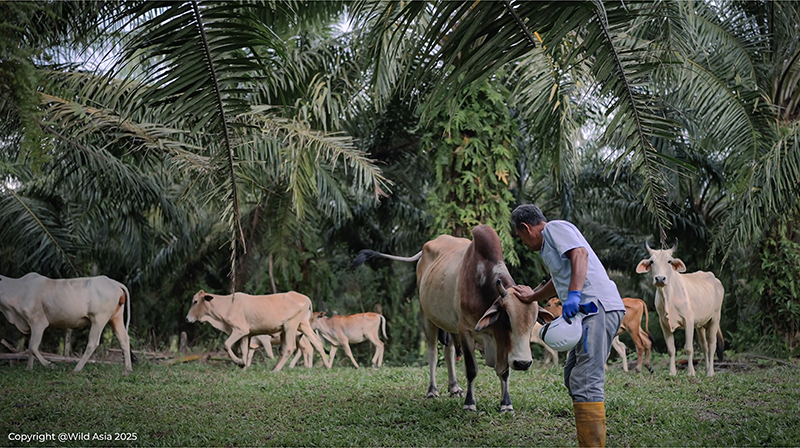
With a herd of 40 cows now, Yusof recalls that the first lesson is to keep cattle away from palms that are younger than 5 years to avoid damage.

Time and again, studies have shown cattle grazing in oil palm plantations is an effective nature-based solution to reduce herbicide dependence, restore ecosystem functions and support regenerative oil palm production.
“For smallholders who lack a sizeable parcel of land to do a rotational grazing system, they can integrate small ruminants (grazing animals) like sheep and goats,” says Badrul. Sheep graze on the soft grasses whilst goats control woody shrubs; they complement each other.
“Small ruminants are easier to handle for women and older farmers. However, you need to build a shelter for them, which incurs extra costs.”
It’s important for smallholders to give their land a 45 to 90-day break after grazing, Badrul added. This rest period allows grass and plants to regrow, helps prevent overgrazing, and protects the soil from compaction. “Given that most smallholders own small parcels of land, working with nearby farmers or other landowners is necessary to make this work.”
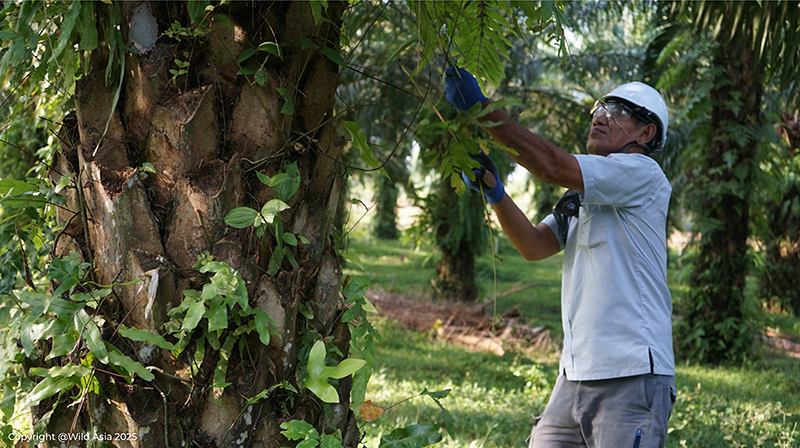
Yusof remains positive, doing the grunt work of farming every day, like clockwork, as he finds the perfect rhythm.
Ongoing Research on Livestock Animals and Palm Oil Production
UPM is currently collaborating with Japan’s Hiroshima University on a project that examines the impact of grazing animals, such as cattle, sheep, and goats, on biodiversity in oil palm plantations.
Led by UPM’s senior lecturer and grazing management expert, Dr Frisco Nobilly, the Living Lab project aims to demonstrate that switching from chemical weed control to natural grazing can introduce more beneficial insects and earthworms, and reduce rodent pests over time.
“Integrating livestock animals can also improve food security by producing palm oil and animal protein from the same plot of land – a land optimisation strategy that can address deforestation as well,” Nobilly explains.
Livestock integration not only strengthens the sustainability of palm oil production, but Malaysian palm oil also provides many health and nutritional benefits. For instance, naturally rich in a balanced mix of fats—about 50% saturated and 50% unsaturated (Omega-9 and Omega-6)—palm oil is packed with powerful phytonutrients such as vitamin E, tocotrienols and provitamin A carotenoids (red palm oil). These antioxidants help protect the body and may play a role in disease prevention.
Steward of the Land
In June, Yusof sold seven cows at RM5,500 each during the Muslim festival of sacrifice, Hari Raya Korban (Eid al-Adha), raking in a sizable bonus.
But raising livestock and growing oil palm demands hard work and grit, he added. Each morning, he arrives at the farm at 8am, tends to his cows and trees, and concludes the day at 4pm after moving his cows back to the barn.
“Once you get used to the grunt work, it becomes a rhythm, just like clocking in to work every day,” he smiles. “If you’re tired, rest. Eat well, and recharge. But most importantly, focus and show up!”
Reference
* Hawken, Paul. Regeneration: Ending the Climate Crisis in One Generation. Penguin Books, 2021.