EUDR Recalibrated: What 2025 Taught Us About Regulation, Reality, and Readiness
The process of EUDR implementation, which has undergone numerous postponements and adjustments, is finally taking shape in 2025, with further action being taken towards its realisation.
 >
>
TWO years after the EU Deforestation Regulation (EUDR) entered into force, 2025 became the year Brussels was forced to confront the realities of implementation. Political resistance, industry pressure, and practical challenges, both within and beyond the EU, reshaped how the regulation evolved over the year.
A Year of Delays, Debate and Data
The EU’s earlier agreement to postpone EUDR’s full application at the end of 2024 was more than an administrative delay. It was a recognition that the regulation, ambitious in intent, was unworkable in its original form. The decision came amid growing unease from European businesses, small farmers and major trading partners, including Malaysia, who had long argued that the EUDR’s complex requirements were neither proportionate nor inclusive.
In April 2025, the first simplification package was introduced, to reduce compliance-related administrative costs by 30%. It allowed annual due diligence statements and greater flexibility across supply chains. Yet for producing countries, including Malaysia, these changes brought limited relief. The EUDR still required costly, tedious geolocation data and full traceability to the farm level, which are complex requirements for smallholders in developing countries.
Then came the much-anticipated release of the EUDR country benchmarking classifications in May 2025. Despite overwhelming evidence of reduced deforestation and strengthened national certification under the Malaysian Sustainable Palm Oil (MSPO) scheme, Malaysia was assigned ‘standard’ risk status. This outcome triggered sharp responses across the Malaysian industry, as the classification directly affects exporters’ costs and competitiveness.

October Simplification: A Shift Toward Realism
By October, mounting political and industry pressure forced Brussels to act again. The European Commission tabled a legislative amendment introducing targeted simplifications, chief among them the creation of a new category: “micro and small primary operators.” These operators, limited to ‘low’ risk countries, enjoy relaxed data requirements (postal address instead of geolocation coordinates) and simplified one-time due diligence declarations.
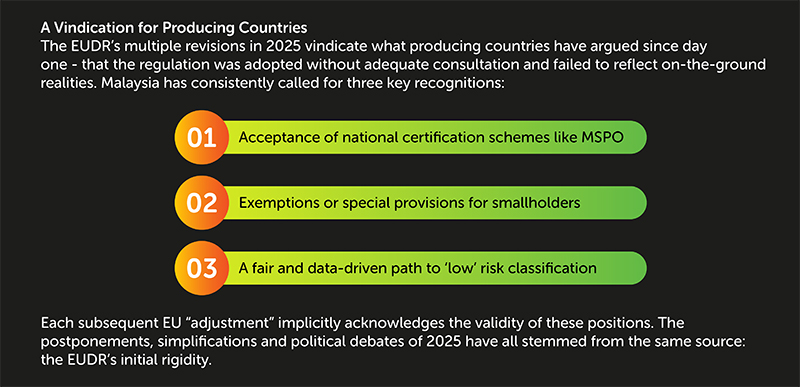
While this concession primarily benefits EU small farmers, it inadvertently highlights a key inequity: smallholders from developing, ‘standard’ risk nations like Malaysia - those least equipped financially and technically are excluded from this leniency. This underscores a core flaw in the EUDR’s design: its most significant flexibility is reserved for those who need it the least. For Malaysia, true fairness would mean extending these simplified measures to smallholders across all risk categories.
Parliament’s Turning Point: A More Workable EUDR Takes Shape
On 26 November 2025, the European Parliament voted decisively on the proposed package of targeted simplification measures to the EUDR, including a significant postponement of application deadlines to 30 December 2026 for large operators and 30 June 2027 for micro and small operators. The vote also endorsed streamlined due diligence obligations, including requiring only the first-placer on the EU market to submit the due diligence statement, as well as special provisions for micro and small primary operators. By backing these measures with a strong majority, Parliament signalled a clear institutional shift toward practicality, rebalancing ambition with operational feasibility and acknowledging longstanding concerns raised by businesses and stakeholders.
This momentum culminated on 17 December 2025, when the European Parliament formally adopted the outcomes of the Trilogue negotiations and approved the targeted revisions, confirming both the extended timelines and the simplified due diligence provisions. The package also introduced a mandatory April 2026 review clause, enabling the European Commission to reassess administrative burdens, system readiness, and data realities. For Malaysia and other producing countries, this could create a critical opportunity to present updated evidence, demonstrate progress, and advocate for fairer treatment going forward, including future risk reclassification where warranted.
Malaysia’s Response: Coordination and Commitment Spectrum
Despite its ‘standard’ risk classification, Malaysia has not wavered. In June 2025, a Multi-Ministerial Special Committee on EUDR was established to coordinate national compliance and engagement. Diplomatic engagement intensified. In September, European Commissioner for Environment, Water Resilience and a Competitive Circular Economy, Her Excellency Jessika Roswall’s visit marked a milestone - her public acknowledgement of the MSPO as “a credible pathway to compliance” and recognition of Malaysia’s significant progress in reducing deforestation. These statements signalled growing EU confidence in Malaysia’s sustainability credentials, even if official classifications have yet to catch up.
SKN: The Next Leap Forward
Central to Malaysia’s EUDR readiness is the upcoming ‘Sistem Kebolehjejakan Nasional’ (SKN) or the National Traceability System, to be launched in early 2026. SKN will serve as a national digital traceability platform integrating MPOB’s SIMS and GeoSawit with MSPO’s e-MSPO. It will provide verifiable, government-backed data on land legality, certification and supply chain movements to ease the process for Malaysian exporters in providing EUDR due diligence-related information.
More than a compliance tool, SKN represents Malaysia’s broader vision: a transparent, data-driven ecosystem that reinforces global confidence in sustainable, legally produced and deforestation-free palm oil.
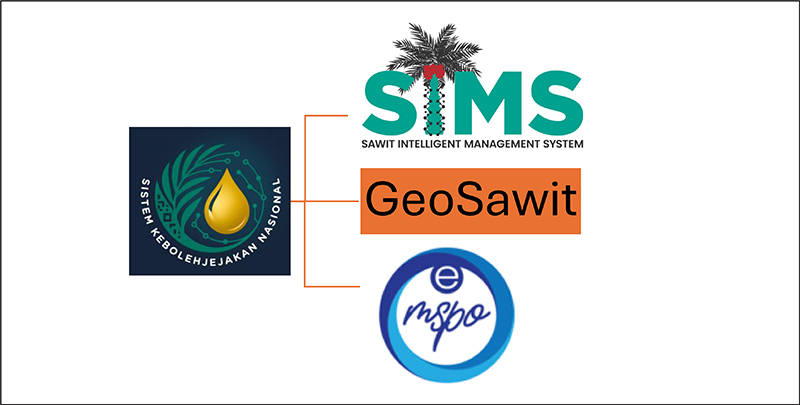
The SKN to be launched in 2026, will serve as a national digital traceability platform integrating MPOB’s SIMS and GeoSawit with MSPO’s e-MSPO.
Recognising Progress, Rewarding Performance
Scientific data support Malaysia’s case for reclassification. The recently released FAO Forest Resources Assessment (FRA) 2025 report has demonstrated that Malaysia has improved its results in addressing deforestation over the last decade, with forest loss volumes and rates now near or below the EUDR’s ‘low’ risk thresholds. This validates findings from Global Forest Watch, which reported a 70% reduction in primary forest loss between 2014 and 2024, providing clear evidence that the country’s reforms and conservation measures are delivering a real, measurable impact. These metrics now place Malaysia much closer to the EUDR’s ‘low’ risk thresholds than before.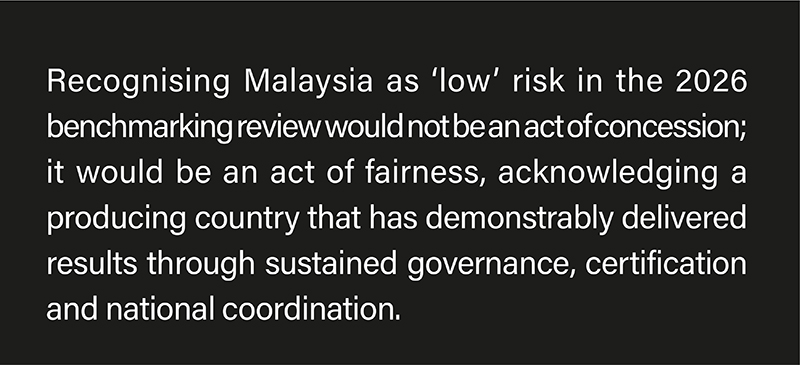
Strengthening Readiness, Broadening Horizons
As 2025 draws to a close, Malaysia stands ready for the EUDR’s evolving reality - prepared, proactive and principled. MPOC will continue its work into 2026, strengthening industry readiness, addressing non-tariff barriers and ensuring that Malaysian palm oil remains globally competitive and recognised as the world’s leading source of sustainable, deforestation-free and nutritious vegetable oil.