The Regeneration Generation

Millennial, climate-conscious, and digitally connected, this couple represents a new wave of farmers who are redefining Malaysia’s palm oil story through regenerative practices.

LAUGHTER and music ripple through the school lab. Four students stand at the front, bottles of liquid in hand, shaking them to the beat of a catchy tune. Their classmates and teachers clap and cheer, voices rising above the music, may the best dancer win!”


What seems like a fun contest is, in fact, a lesson in sustainability.


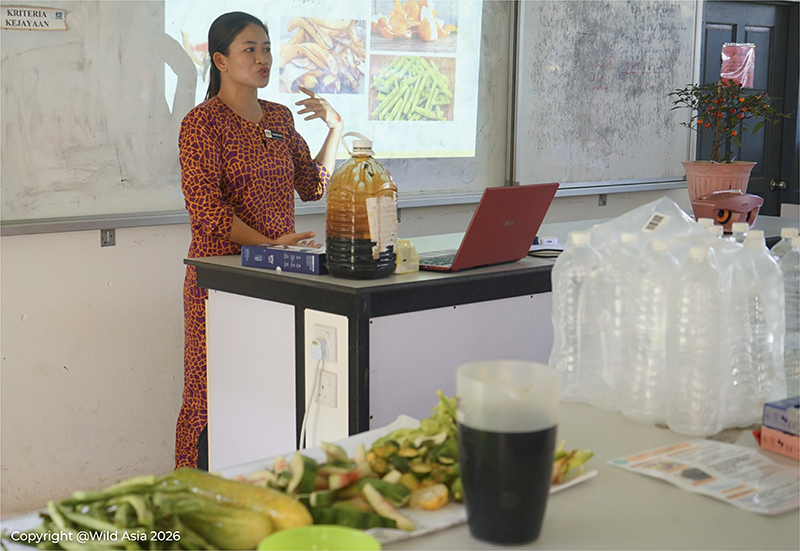
Inside those bottles are liquid enzyme fertilisers, freshly concocted from vegetable scraps, fruit peels, molasses and rainwater. The activity is part of a BIO Juice Tutorial workshop led by Prissentiazie Juhan, a teacher at SMK Beluran in Sabah.

Alongside her students and fellow teachers, she demonstrates how everyday food waste can be transformed into a natural fertiliser that nourishes plants, restores soils and reduces chemical use. It is hands-on education designed to connect the dots between food, farming and land stewardship.


“By learning through doing, the next generation will understand how healthy, living soils sustain life – and those who live off the land,” says Prissentiazie, 36, who also advises SMK Beluran’s Eco Club. For this workshop, she invited students from neighbouring schools to join, spreading the message beyond her classroom walls.

She and her husband, Ferrigno Marudin, are second-generation oil palm smallholders who know first-hand what it means to live off the land. Unlike their parents’ generation, however, they place equal weight on social, environmental and economic success.

This millennial couple embodies the Regeneration Generation – hands-on farmers reshaping the palm oil narrative from the ground up through regenerative farming practices, knowledge-sharing and community action.

The Long and Winding Road
Raised in villages just 30 km apart in Beluran District, Prissentiazie and Ferrigno’s lives unfolded along parallel lines. Both grew up in smallholder families, dipped their toes into farming from a young age, walked the same school corridors and inherited land.

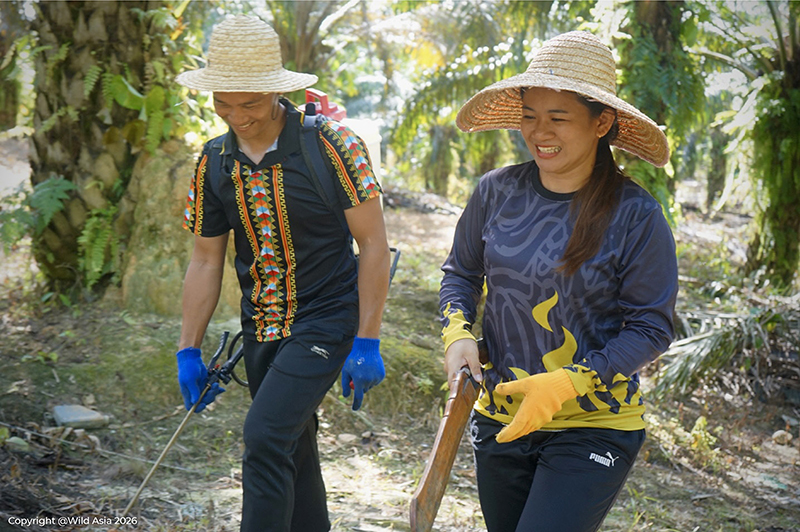
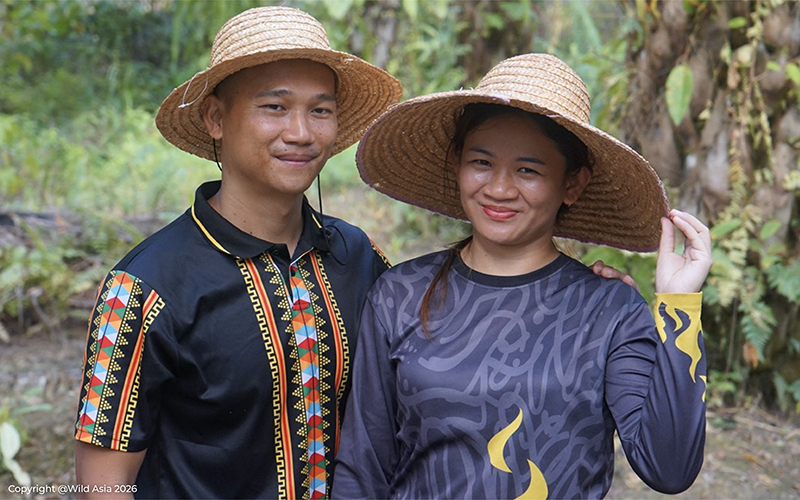
Second-generation oil palm smallholders, Prissentiazie and Ferrigno.

Today, she manages a 3.89-ha oil palm plot in Kampung Kuala Sapi, while he owns 3.11-ha in Kampung Manduring. Both farms received MSPO (Malaysian Sustainable Palm Oil) certification in 2023 and international sustainability certification in 2025. Despite their full-time jobs, Ferrigno is a firefighter at the Beluran Fire and Rescue Department and raising three children, they remain closely involved in their farms.

Beyond hiring contract workers to do the heavy lifting, like harvesting and collecting fresh fruit bunches (FFB), they handle weeding, fertilising and monitoring tree health. Ferrigno also set aside an acre of his land to grow jackfruit, rambutan, longan, and durian merah (Durio kutejensis) to supplement their family income.

“Farming figured so largely in my childhood that it has become second nature,” Prissentiazie explains. Her father passed away in 1997 when she was eight, leaving her mother to become the sole breadwinner. Oil palm was their family’s lifeline.

Then her two oldest siblings joined the rural exodus, leaving Prissentiazie, the second-youngest of 12 children and her other siblings to help out on their family farm.

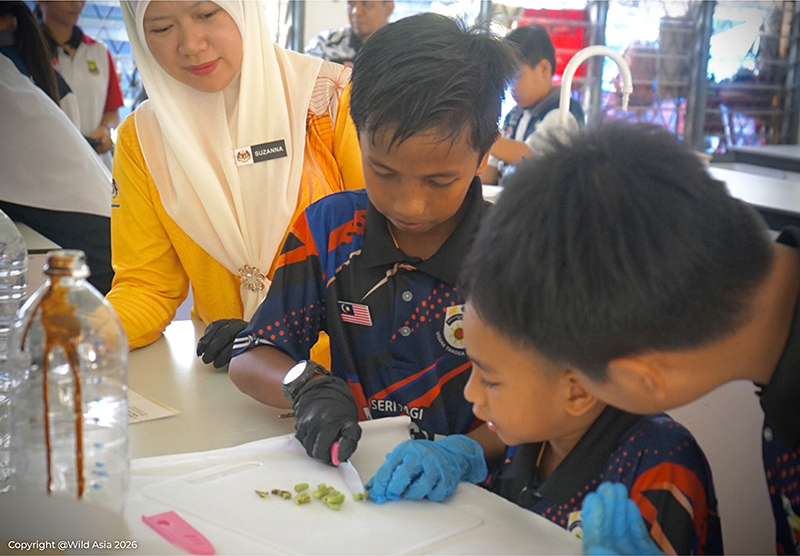
Students at SMK Beluran, Sabah learn sustainability through a hands-on BIO juice workshop.


“I still have vivid memories of painful jabs from palm thorns when collecting loose fruits or swinging a heavy parang (machete) to manage weeds because we couldn’t afford herbicide,” says Prissentiazie, smiling.

Their family home was more a pondok (hut) than an actual house, she added. Monthly earnings from oil palm were less than RM1,000 during the late 1990s. But they were never hungry. They grew vegetables, fished and hunted for meat. And every child had the chance to go to school.

“My late mum always said, ‘Study hard or your life will be as tough as mine’. That made me see education as the key to a better life – and it became my greatest motivation,” Prissentiazie recalls. Her mum was illiterate and got married at 13. Prissentiazie is the only member of her family to have graduated from university.

Like his wife, Ferrigno started helping out on the farm when he was seven. His father was a civil servant and oil palm provided vital extra income.


One of the many activities during the BIO Juice Tutorial workshop led by Prissentiazie Juhan.

“We struggled financially, but we always had the basics: food, a roof over our heads and an education,” says Ferrigno, the fifth of eight children. After Sixth Form, he trained in oil palm plantation management under the Malaysian Skills Certificate (Sijil Kemahiran Malaysia) programme and later worked as an estate supervisor for a Sabah-based plantation for five years.

“That job really taught me a lot about oil palm – the know-hows, the struggles, and showed how palm oil can transform livelihoods,” says Ferrigno, 36. “It’s tiring juggling a full-time job and farming, but quitting never crossed my mind. I’m used to the hard work and the motivation to maximise yields keeps me going.”

Farming with Nature
The couple plays by the book when it comes to standard oil palm good management practices. And it shows. Prissentiazie’s average FFB yields range from 10 to 15 tonnes (per 9.6 acres), raking in an average monthly revenue of RM6,000. Apart from judicious use of chemical fertiliser, they apply chicken manure and decanter cake to nourish the trees and soil.

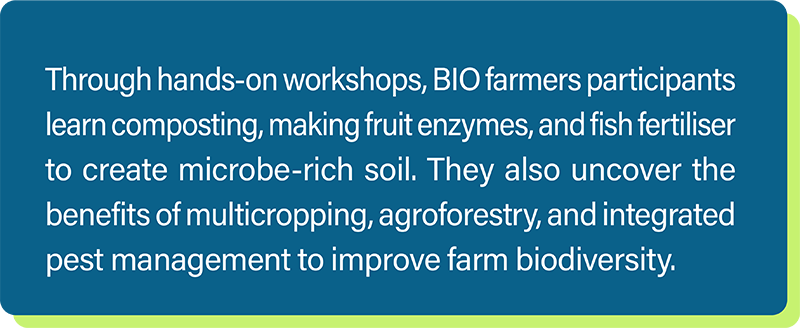
But they are always trying to do better. When Prissentiazie got wind of Wild Asia’s WAGS BIO programme from a former university mate, she and Ferrigno leapt at the opportunity to acquire new insights and skills.

The regenerative farming approach focuses on soil health, organic matter and reducing synthetic inputs such as pesticides and chemical fertiliser. In short, healthy soil is key to thriving, resilient crops.


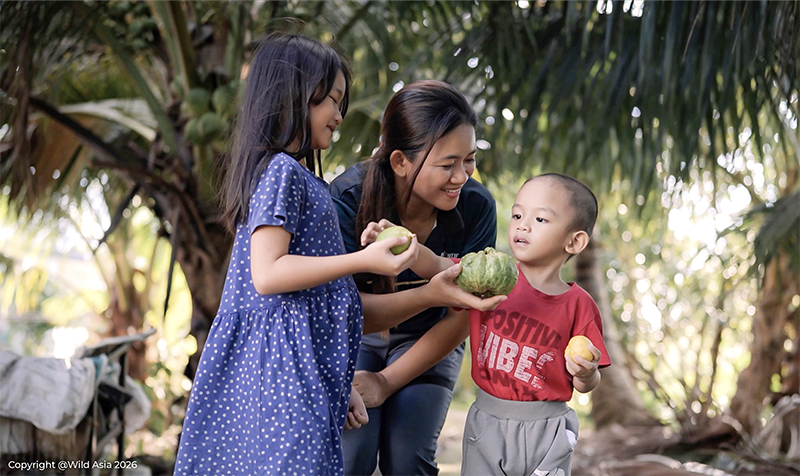
The home garden and farms are playgrounds for their kids. 

“Before this, all I knew (from the estate experience) was conventional farming, monocropping and heavy use of fertilisers and pesticides,” Ferrigno admits. “I never really thought about what that does to the soil. After learning about regenerative practices, it hit me – all those chemicals strip away the nutrients and organic matter, degrade the soil and dry it out. If we keep farming like that, the land will be depleted in the long run.”

Since carving out BIO plots (chemical-free plots) on their farms in August 2024, their production costs have dropped by 30% after switching to manual weeding (using a grass cutter) and DIY fertilisers. While the yields are too early to measure, they’ve already noticed more earthworms, an indicator of a healthy soil with organic matter and sufficient moisture.

For Prissentiazie, it seems the stars finally aligned. She has been tending an organic home garden since 2018, growing a variety of leafy vegetables, herbs, and fruit trees, including guava, papaya and lemon.

“When it comes to feeding my family, I’ve always insisted on no chemicals.

Organically grown food also delivers spin-off environmental and social benefits,” she asserts. Prior to joining BIO, Prissentiazie trawled the internet for DIY tips on natural fertilisers and pest control methods.

“Of course, I watched YouTube tutorials, but nothing beats hands-on learning through practical workshops.”

Their next step is to trial biochar for soil enrichment and carbon sequestration. But lack a lack of time and high labour costs are their biggest hurdles.

“With full-time jobs, we rely on hired help and navigate our schedules to attend BIO workshops. But we do our best, given the circumstances.”

The Ripple Effect
Which brings us back to the BIO juice workshop at school, one of the many spillover effects from Prissentiazie’s WAGS BIO journey.

“Environmental consciousness has to be shaped early in life, at school and at home,” says the educator with over a decade of experience. “My students will become the next generation who care about environmental conservation and safeguard the planet.”


Health Benefits of Palm Oil
As an educator and an oil palm smallholder, Prissentiazie also passes on the knowledge about palm oil’s nutritional values to her students. At home, she uses palm oil for everyday cooking, especially for deep-frying and stir-frying.

“We know that palm oil is rich in Vitamin E (tocotrienols), which has proven benefits in supporting heart health and the immune system,” she adds. “Besides, dishes cooked with palm oil taste delicious and retain their original flavours!”

Over the years, various studies have shown the health benefits of palm oil.


Regenerating Young Minds
At home, farming doubles as family bonding time.

“Since our schedules are so busy, our home garden and farms are playgrounds for our kids,” says Prissentiazie, chuckling. “It’s also where we spend quality, golden moments.”

Their kids, ages 3 to 9, love getting their hands dirty, playing in the mud and fishing at the pond on their dad’s farm. The couple teaches their kids how to plant seedlings, nurture them and watch them grow.

“It’s a way to teach life lessons: take care of the land well and it gives back. Same with life, put in the effort and you’ll see the results,” Prissentiazie muses.

“At the end of the day, we just want to keep farming sustainably and leave behind a legacy our children and the next generation, can carry on,” she sums up.

More from SPECTRUM

Malaysia’s palm oil sector is entering a defining phase shaped by climate policy, sustainability expectations, and the emergence of structured carbon markets.

Swinburne University and Sunway University conducted a preliminary study on the carbon credit potential of the Malaysian palm oil industry.